
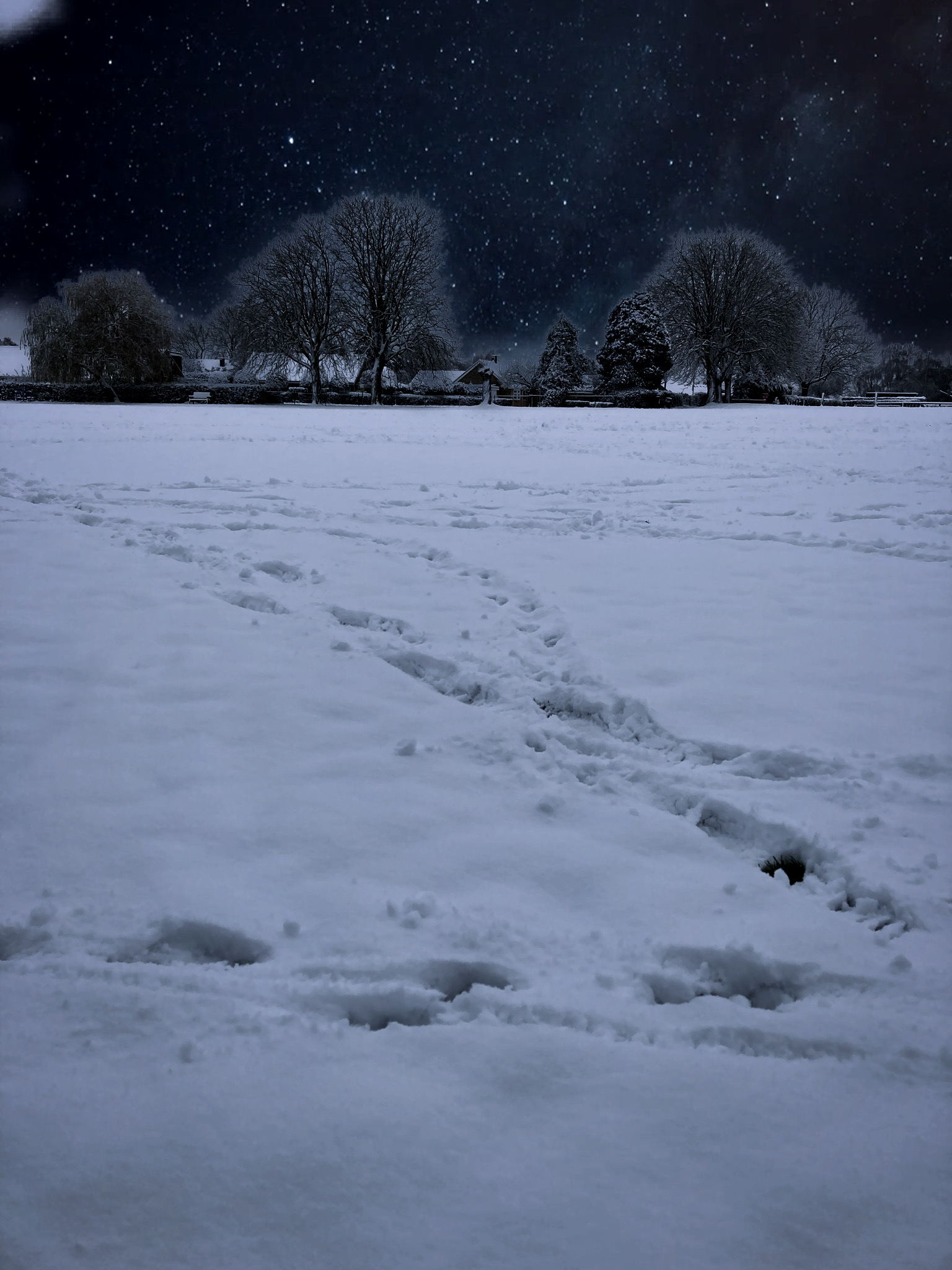
Only part of him was ahead of the clock… At first, when the moment exploded before him, Dunne, could think not of the future, nor of what had gone before. Just like the dream he could only gaze at the smoke rising up the hill in the field holding up the lightning tree, which would come into view much sooner if it wasn’t for the hindering heavy snow underfoot. Basil barked and raced ahead in leaps and bounds, his ears flapping as he took the air. Occasionally he would turn, tail wagging, as if to say, speed up or the spectacle might be over before we get there.
From the fact that the smoke reached higher than the tree-line beyond the large pond Dunne could tell where the car had come to a halt.
The low hill, an upside down hollow, sat as the shadow twin of the Hilltop housing St John’s triangular ship sail, at most times appearing as a dark silhouette against the sky, but today the sail on the horizon was white, the signal that Minotaur had been defeated and Theseus had navigated his escape from the subterranean underworld using the coloured thread.
In the dream there was an almighty… wow… yes just like that, and following the bang… yes, there was the ball of flame shooting darker smoke into the original white cloud.
Would the scene be exactly the same as the dream? He kept looking to the left hoping that the base of the treeline to the pond might be visible. In the dream a dark shape glided at speed from right to left towards the point. In the dream it was more like a rolling smudge of charcoal on paper, like the eye make up of the waitress at the Dream Cafe, that’s a different dream, she won’t be working there for twenty years, he knew that by the date on the newspaper which she always places on his table as she picks Basil up, it always says 1993. The date on this morning’s paper was 1973, the exact date of the newspaper in the dream. The scene before him felt different to the landscape of his vision, in which he saw shadow figures moving through a Breugal painting trapped inside a silent snow globe.
Later the moment would be picked apart, piece by piece, petal by petal, by whatever echoes attached themselves to eye witness sense data. Dunne was a man of science and he nailed himself to one particular branch of that tree. Evidence. The senses opened different portals to those in his dream.
Conclusions concrete: The air, that day, held the scent of “petrol and snow”, a metallic tang that would forever cling to the memory, a discordant perfume. It was the scent of a truth fracturing. The structure of that morning, a meticulous arrangement of events, would now being re-examined, disassembled, like the administrative charts in the departmental offices, revealing the faint, almost ghostly lines of an earlier, more fluid understanding.
Dunne’s own notebook, filled with his precise, almost calligraphic script, was far more intricate than the Desk 128 file. Ink lines referenced each arrow that flew from the many different narratives. The map of the paper round found in a pocket, numbers traced on the back of an envelope inside a square; a triangle representing the church on the hilltop, a silent, immutable witness, piercing the low sky; the mobile library, a temporary ark of stories, its regular route a rhythm across the landscape forming a circle; the new school library, behind the pond, where the order of words would be meticulously catalogued, offering slices of Plato and Bacon, a solid structure housed in clearly labelled shelves, unlike the disorder of what was to come.
It was Dunne’s original statement from 1973, a fragile document sitting on Desk 128, that held the key. He had noted, with a quiet precision, that despite the apparent contradictions in the eyewitness accounts, it was possible, perhaps even probable, that each observer was indeed speaking their own truth, a unique refraction of the data available to their individual senses. A mosaic, not a single pane of glass. A moment seen through a crystal pyramid.
Observer 1: spoke of a sound, an “explosion from the link road”. And a sight – the sirens, yes, seen, but not heard. What they meant, Dunne posited, was the flash, the pulse of light, reflected on the dense, low-lying fog above the pond. Only later, when the sound waves had journeyed through the opaque air, did the actual wail of the sirens register. This, he reasoned, would have been the patrol car, momentarily stalled on the treacherous slope below the pylon. A brief, almost cinematic tableau of arrested motion.
Observer 2: was in transit, on the Barnet by-pass, a fleeting presence. They saw a “plume of smoke”, then a “flame”, a sudden, aggressive blush, followed by a larger, more diffuse cloud. They had just noted the time, a private tick of the clock, as it had dictated a small, personal decision: available all night roadside coffee, or onward? The driver, divided in thought at the very moment of the explosion, a small split in their consciousness opening to a chasm, an empty stomach, a subway passageway, an underworld stream, a transport cafe steamer, a future space through which time passed like the internal workings of a clock being sucked into a a jet engine.
In motion, all things are relative. Dunne, with his quiet understanding, knew that Aristotle, in his “Poetics”, available in the mobile library, spoke of the dramatic intensification achieved when characters are related. And in this instance, they were. Deeply.
Observer 3: the patrol officer, his statement stark. But, Dunne had observed, it failed to account for the “echo”, the subway slapback, the deceptive rebound of sound, or the basic science, the very ABC of Relativity, explained by Bertrand Russell, the book Dunne had left on his desk. Sound, for this observer, had dominated, a raw, percussive force, for their sight had been blinded by the thick, obliterating bank of fog and the falling snow. A world reduced to a single, insistent sense.
Observer 4: from the snowbound southbound train, a distant, muffled perspective. The flame, they recalled, had seemed to strike the low-lying fog bank with the swift, dispassionate violence of a “lightning flash”. The snowstorm, a relentless, insistent presence, had prompted everyone to echo phrases: “slow motion,” “painted snow globe scene.” Words, repeated ad nauseam, until they lost their currency, their very meaning. Sight, from this vantage, had dominated, for the distance had swallowed all sound. Dunne had scribbled a sense data Venn diagram in his notebook, overlapping circles showing the curious intersections of their perceptions.
Observer 5: Dunne himself. Observer 5, everything revolved around that statement, Dunne’s singular confirmation, a rare individual who had experienced the event in its multifaceted totality. Sight, sound, touch, and smell – all were registered, woven into a comprehensive tapestry of perception. He had discerned the twin plumes of smoke, yes, but also the subtle shifts in the windborne scents, a detail that allowed him to place the figure from his dream, in the exact arc of movement, in one swing of the hypnotic watch, it was there, surely, it took its final swing, the moment exploding, tiny cogs and watch wheel workings dropping from the dream into the snow scene, the dog a silent, olfactory witness, observing from the periphery. Dunne, with a knowing nod to the “grand illusion” of sensory input, the watch wheel whirring in the air matched the blur of the silhouette, adding two timepiece wheels to the escape. He later regarded them as bicycle wheels, yet only on evidence provided by the tyre tracks. In his own notes, added later, he thought it was the dog who alerted him to the presence heading from the car to the pond, where they found the pair of boots belonging to the driver, next to a hole in the ice. Those boots would soon wander from the evidence store, but not before Dunne had inspected the soles for the mark of Mercury. The same mark found on the ghost train line behind the Comet Hotel. It was all in the notes, including his own part in the driver’s escapade.
Observer 6: Redacted, another thread in the intricate tapestry, which unfortunately has been sealed until the year 2044.
Observer 7: code named Mercury. The driver of the vehicle which exploded. He slipped into the fog, a disappearing act, the invisible man. For all we know, Cartesian coordinates of two bodies in motion will be reported later, perhaps, somewhere behind the Iron Curtain, where Observer 7 was assumed to have ended up, unable to resist the pull, the undeniable attraction of the Urals, those ancient mountains. The report, if it exists, would surely have included aeronautical terminology, precise measurements, and references to the Space Time chapter in The ABC of Relativity. A quiet testament to the enduring, subjective nature of truth, a series of viewpoints observing the same moment in time, fragments of which might echo traces of Dunne’s dream, the patterned mosaic of a different moment which happened ahead of the clock.